
4th Generation University (4GU) roadmap
(migrating content, posted on February 12, 2024 )
An evolutionary power pushes societies to create a Next Generation University (NGU), now towards the 4th generation university (4GU). In the 1940s — 1960s, it was a natural social evolution, yet leadership culture and technology were not ready. As of the 1970s, a struggle is seen between conservative forces and countercultures with a Do-It-Yourself (DIY) morality. Now (the 2020s), leadership culture is shocked enough, and technology development has matured enough for an NGU to bootstrap itself. Next to the general trend, this article gives our roadmap for 4GU. I will improve the concept of a Technology Readiness Level (TRL) train (first described in the previous article). It will take time and a lot of resources, but at least the road ahead becomes clearer. [ Image reference ]

NGU is an evolutionary force belonging to the whole of humanity. This force has been accelerating and this is creating a revolution. In the first section, I will introduce NGU and the revolution. The force of nature is powerful and to use this power of acceleration, development can be retrofitted. In the second section, I tell how I have retrofitted my cybernetic research on radical innovation and developed a theory for NGU. Section three will consider the fundamentals of the theory and the next sections describe the 4GU roadmap.
With my PhD the research was theory. The NEON research project changed it to practice. NEON is a crossover program with 35 research projects, from different universities, with 20 partners. In the previous article, I did a thought exercise to valorize NEON research by projecting all 10 Work Packages (WPs) to one market, in particular festivals. The exercise gave me insight into how the WPs had a particular alignment I like to call the TRL Train:
Locomotion: The part on energy (WP1–3), can become a venture (TRL5)
Coal wagon: The part on mobility (WP4–6) would need validation in the lab (TRL4)
Passenger wagon: The human side (WP7–9) would require a proof of concept (TRL3)
Restaurant wagon: Integral modeling (WP10) expanding to 4GU technology (TR2)
Universities today have technology transfer, in our metaphor, this is only the locomotion and driving to higher TRL levels. For 4GU the transfer needs to become integral and so upp other wagons. The coal wagon represents earthly impact. The passenger wagon represents social impact. The restaurant wagon is about collective intelligence and how the IT infrastructure of a university gives this 4GU a new kind of agency. Agency to tackle grand challenges (see also previous NGU papers).
The TRL train shows a process with overlapping development, like a music canon, where different parts are at different TRLs and each goes up a step. This implies that most applicable research (TRL5) has a way to uplift research lower on the TRL ladder. In other words, NEON, and similar projects, have produced the foundation that can now be used to begin the 4GU roadmap. TRL5 is only halfway through the TRL ladder. Keep in mind we are considering the TRL of an institute. We don’t expect mass systemic production of 4th generation universities (i.e. higher TRLs) in the near future.
Before going into details, allow me to reason about the development frequency. It took 5 years (2010–2015) to design the NGU theory (TRL0). It took 5 years to find a new fit, but then the theory became practice (TRL1). NEON started in 2020 and again it seems to take 5 years. Starting the project valorization this year led to the 4GU roadmap, explaining the technology design (TRL2). We can assume a 5 years development frequency and should include some time for delays, this brings me to the following forecast:
2025–2032: demonstrating the technology design (TRL2)
2030–2038: creating the 4GU proof of concept (TR3)
2035–2044: lab validation (TRL4) on Grand Challenges
2040–2050: 4GU operational (TRL5) as a 4th pillar
The timeline is significant as 2040–2050 is also described as the Technological Singularity (TS). If policymakers step in, we can still expect to reach 4GU operations by 2040. Without a major disrupting event or the formation of an opposition, we can expect 4GU by 2050. The previous article considered why 4GU and TS align from an evolutionary angle. This article will try to stay as focused as possible on the roadmap.
1 From NGU evolution to revolution
The evolutionary process of NGU is a gift of humanity to itself and helps us transform societies. Historically several NGU events have occurred, each during their own desperate times. Each NGU transition adds a pillar. The 1st generation (1GU) is ancient scholarly institutes of wisdom going back to before the Common Era (BCE). In 1GU we see scholars using reason and writing to develop the social sciences (i.e. the great philosophers). Our classic universities are the 2nd generation (2GU), adding natural scientists who build instruments and laboratories to develop models of nature. For some time indication, Galileo Galilei (1586–1642) is often seen as one of the pioneers of 2GU. The 3rd generation (3GU) splits natural sciences into the exact and applied sciences, creating Technical Universities (TUs). The first TU was founded in Paris in 1794 and many would follow. A TU also has a 3rd pillar on valorization, entrepreneurs and investors join universities to develop ventures.
1GU produces wisdom, the 2GU produces fact, the 3GU produce technology, and now a 4GU produces social transitions. History tells us of political prestige scientific programs with such impact e.g. the atomic bomb (1940s) and the space race (1960s). This co-existed with social unrest at the bottom, demanding a fair piece of the welfare. Because leadership culture was not ready and demands were not answered a counterculture movement began growing. Particularly relevant for 4GU are the student revolts in 1968.
The evolution at the top and the base never stopped but got more ubiquitous, in particular with the development of software. The development of hardware keeps having this relation to Technical Universities, creating the current high-tech industry. Software is a very different story, showing strange dynamics, like the perpetual state of inexperience: As of the 1940s, the need for programmers doubled every 5 years, creating a state of never having enough teachers. By the end of the 1990s, the effect even leads to a break with universities and a culture of lean-agile experts. We observe how universities fall behind, while software is eating the world. Let me take a step back to the pivotal moment between the 1960s — 1970s and give more detail on countercultures, co-evolving with the software culture.
Countercultures of the 1960s were relatively peaceful and focused on spiritual communities. The power struggle with conservative forces made countercultures more disruptive, with a clear DIY morality, like the punk movement in the 1970s — 1980s. In the same period, something important happens to software development. Until the 1970s, closed-source software was uncommon. With the private sector taking over computer development, this changes. A power struggle would emerge where Free Open-Source Software (FOSS) eventually prevails. Today closed-source software is mostly the exception, at least at the code level, not so much at the application level.
The lean-agile culture of abundance will stay in a perpetual state of struggle with the old culture of scarcity. They would also challenge the system’s sovereignty, first as digital nomads and later by developing digital ways of sovereignty. Like digital currencies, not bound to any nation (e.g. Bitcoin). When you dive deep into successful DIY communities, it is interesting to see the same counterculture spirit from the 1960s. The counterculture spirit is a small candle of hope in desperate times: financial crises, growing populism, climate change, a pandemic, and nations building up for war.
Current development has an apocalyptic feeling, like the mythical story of Pandora’s box, one thing not yet released from the box is hope. Recognizing how society has opened Pandora’s box and how only hope has not yet surfaced, was first used by Bruno Latour (1999) in his essay on science studies. It is remarkable how he expresses the concept of alternative facts, almost two decades before it became a topic in 2017. This shows how understanding the cybernetics of weak signals can provide ways to forecast with accuracy. In the remarkable book, Latour describes the pumping heart behind science in action. His work on the origin of science is an important foundation for my own work on NGU.
2 The background story
Cybernetics is a field of systems science that studies circular causal systems. The central topic of my cybernetic research was the System of Creation (SoC) producing novelty. The research began with Artificial General Intelligence (AGI) and Meta-System Transition (MST). AGI is about understanding human-like intelligence by AI development. Meta-System Transition (MST) is about interaction turning into coordination and finally in control. Like the MST in the origin of life, from single cells to multicellular life.
To validate my SoC research in practice, I develop systems for collective intelligence, to bootstrap radical innovations. Collective intelligence is a MST version of AGI. Bootstrapping is a technique known from software development to build bootstrapping compilers. I referred earlier to the bootstrapping process as a musical cannon. In the next section, I will give details on the theory of SoC, and the practice of bootstrapping. This section is about the journey that started when I was a software developer and researcher creating my first experiments and how following that road led to NGU.
My research as a programmer already started during my master’s studies (2002–2004) and in 2005 my role shifted to being an entrepreneur and educator. As an entrepreneur, I participated in DIY communities, co-creating events for social innovation in a dominant technology setting. As an academic educator, I developed radical innovations in higher education. The first radical innovation (2006) related to a wicked challenge in the content: “How do you teach a course if the topic is outdated before the end of the term?”
The course was about teaching business managers (i.e. master-after-master) to handle the complexity of software development as a Challenge Based Learning (CBL) experience. The CBL was to develop digital startups and give the manager a taste of entrepreneurship. I still love the first blog, coming from a manager at Microsoft with the title “So I’m a Belgium, but yesterday’s course was a culture shock” (the side is sadly offline, so no reference). After the first year, showing how banking managers were able to code as programmers. I got free range to keep using this course as my living lab.
The radical innovation in higher education was first a side activity for the research, the focus was on co-creation with IT-management professors to build radical innovation support for R&D. The design couldn’t come at a worse time. We had partners meeting to bring the design to the field, but partners pulled back because of the financial crisis (2008). So I pivoted, and most of the design stayed theory. Now I focus on a bigger radical experiment on higher education, but I wanted to dive deep into the DIY community first to understand the innovation observed.
During a conference in Copenhagen (2010) and in Chicago (2011) I interviewed the leading entrepreneurs of a DIY community to capture the system behind the self-organizing innovation. The cybernetic system was the effect of collective intelligence in a flow known as a dissipative system (see my paper of 2011). To my surprise, I saw the system implode in the next two years. At the same time, I set up a second radical education experiment. Another CBL course had a radical challenge in two years. In the first year (between 2010–2011) I became a tutor for the course and designed with the professor a radical innovation solution for the next year.
We developed an IT platform to scale the teacher. This solved the perpetual state of inexperience mentioned earlier. The IT platform begins as a peer-learning platform and quickly shifts to a leadership platform. Where CBL first turns the teacher into a coach to inspire the students. Now the platform turns the coach into a manager to delegate work to the students. This is how I was able to supervise all 300 students individually, which is a factor 10 increase to the course setup in previous years.
I build a platform to keep control and delegate the teaching to the students as a learning experience. This learning experience empowered students in a leadership role, creating an interesting Popup Pyramid (PoPy) of collective intelligence. Interestingly, once the pyramid exists, it does look similar to how a larger organization delegates work by management. After the experiment, the PoPy process was the inspiration for a PoPy method to avoid the collapse observed in the DIY community.
The PoPy method was worked out between 2012–2014. As a final exercise, I created the first 4GU design in my last chapter. I asked colleagues for a good name and it was Clément Vidal who expressed it as the Interversity. The Interversity is an 4GU based on insight from digital DIY development, showing how distributed and self-organizing NGU can become.
Depending on the angle, we can find many good names for NGU. In 2021, I met Maarten Steinbuch who is a professor in Control Systems Technology (CST) and he describes NGU as the 4th generation University. This name is strongly influenced by technology development. The historical reference makes the 4th University very easy to introduce, as I did earlier. Maarten Steinbuch and Auke Hoekstra started the NEON project a year earlier and it will run until 2026. The project has a strong technology focus and was a great gift to verify the first phase of my NGU theory.
Thanks to managing the NEON project I noticed how well Technical Universities are positioned to bootstrap NGU and described the NGU evolution to Grand University (TU2GU). In this article, I will report on the TU2GU intrapreneurship. Now with the TRL train, I have what is needed to build the NGU roadmap. GU adds another angle next to Interversity and 4th generation university. I would love to see many colleagues describing other NGU angels to enrich the picture we have of this evolutionary development that belongs to us all.
3 Bootstrapping, PoPy method, and STP-X
To explain a bootstrapping compiler, first consider a simpler example. Take an arch bridge, like the ancient Romans built. The wooden scaffold keeps the arch together until the keystone ensures the structure can support itself. For a bootstrapping compiler, we build an interpreter as a scaffold. The interpreter is used once, so the application can compile itself. Tricky with the compiler is the virtual nature, so the compiler is the keystone (i.e. full recursion).
The bootstrapping process and the keystone are the foundation. In my System of Creation (SoC) the keystone is a workspace where four bootstrapping processes create “the origin of X”. The X stands for anything. Many colleagues from different domains study a concrete origin story: the origin of life (biochemical research), the origin of science and religion (sociological research), the origin of cognition (psychological research), the origin of words (AI research), etc. While the colleagues refer to “origin” this is not a reference to a historical event. The origin is the keystone of bootstrapping processes. This is how all my non-cybernetic colleagues do fieldwork and make a fundamental theory possible. The theory needs to be verified, which brings me to experiments.
From the experiments, we learned how a Popup Pyramid (PoPy) process can create a required workspace as the top layer. The concept of a PoPy process in cognition was first described by Jeff Hawkins (2004) in his book On Intelligence. This is how I recognized the cybernetic system behind the leadership platform as the PoPy by collective intelligence. It shows how I work: developing the leadership platform was pragmatic and needed navigation via tension, which produces novelty. In retrospect I analyze the novelty to understand the cybernet dynamics, so next development can use such insights and dig deeper.
Bringing this experience back to the theory led to describing NGU and a 4th pillar bootstrapping the Popup Pyramid (PoPy) method. Just like the bootstrapping compiler is compiling itself, now the 4th pillar is developing itself via the PoPy method. Once operational the 4th pillar uses the PoPy method to create impact. The PoPy method has five phases with three important transition gaps that pop up to a pyramid with three layers:
Base R&D layer = community of practice by Research & Development
Middle E&R layer = community of learning by Education & Research
Top L&R layer = distributed government by Law & Regulation
The popup implies each step a layer is added and the lower layer(s) expand. In the figure below a triangle represents a group (about 10–30 people) and in every phase, the group increases with factor 10, until we reach the edge of the pyramid. The PoPy method has five transition phases. The first four are shown in the picture below. In the end (i.e. the fived phase not shown in the picture) we would expect a governance group at the top level (10–30 policymakers), a community of learning in the middle (1k-3k students and researchers), and a community of practice at the base (100k-300k R&D workers). This is of course theory. The blue and green rectangles are not part of the PoPy method. The blue rectangle is where the NGU bootstrapping is at the moment. The green rectangles show what exploration has been done.
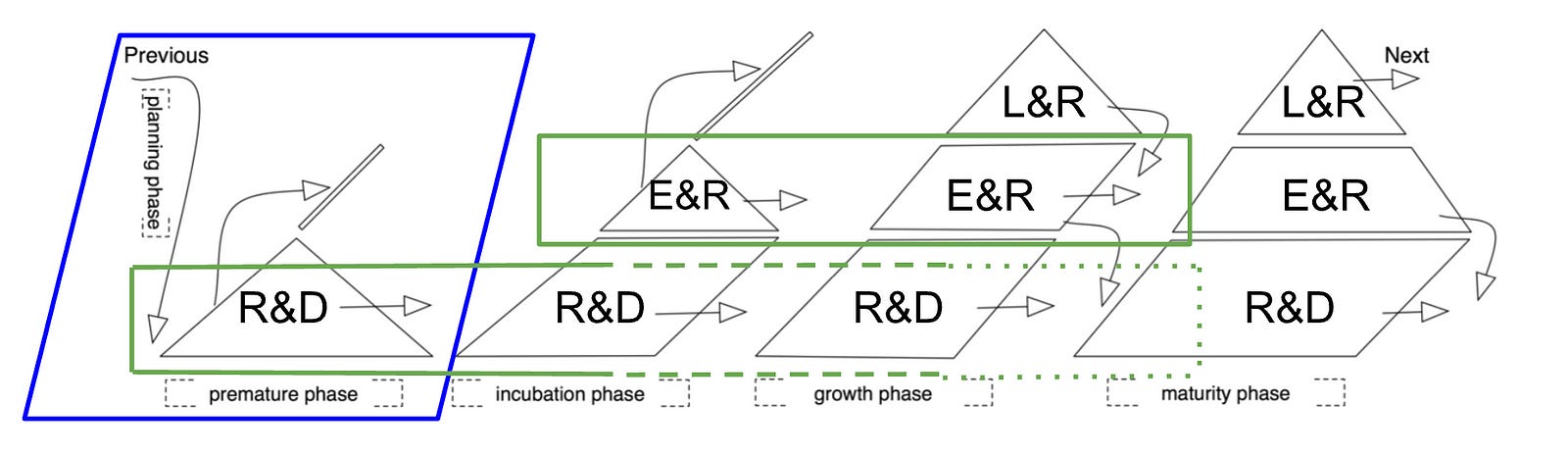
The exploration started at the middle E&R layer, with the transition phase from incubation to growth, as explained in the background story. The theory describes the context around these radical innovations in higher education. It became practical with the NEON project: 35 researchers from several domains, demonstrated the premature phase. NEON was an exploration of the whole R&D layer. The TRL train is seen in the picture as a fading green triangle, reaching the gap with the maturity phase.
This brings us to a challenge regarding PoPy as a bootstrap process, eventually, I expect this nice PoPy method will emerge, but at the start, it is all much more VUCA (Volatile, Uncertain, Complex, and Ambiguous). VUCA is an essential condition for SoC (see article on self-synchronization). The deeper we reach in the TRL ladder the more advanced cybernetics are needed. The deeper layers relate to the human factor. In particular, the PoPy method creates a workspace that resolves a Social Tipping Point paradoX (STP-X): the phase shift is perceived as a market breakthrough and a community collapse at the same time.
The STP-X is the dramatic effect with a culture of hope turning into a culture of cynicism. When cynicism becomes the driving culture of a society, we notice the rise of authoritarian regimes often first elected via democratic process. To create impact, it will be important to keep the spirit of hope for the whole society. Notice how a project like “Boots on the Moon” in the 1960s inspired hope, while the current “climate crisis” is cynical. The narrative we should have at this moment is “return to the garden of Eden”. This narrative can be supported scientifically by understanding the cybernetic dynamics of green energy solutions and its natural tendency to create abundance and sustainability.
To become a bit more technical, we can see how STP-X is a challenge with the free-rider problem: a type of market failure that occurs when those who benefit from resources, public goods, and common pool resources do not pay for them. The effect is the tragedy of the commons: when overconsumption of a regenerative pool turns the abundance into scarcity. The effect is known from the agriculture industry, when the pool is ecologic, like overfishing. The cybernetic system behind the ecological case can be used for a sociological case. Now it is about the pool of talent and the culture such a pool creates.
While the balance is delicate, it is still in the realm of control. The general cybernetic solution to STP-X is demonstrated in ecology. Indirect interactions can control entire ecosystems: trophic cascades. The effect is not just theory (TRL0), it is used to restore nature (TR1). The process is to identify the right alfa species to ensure maximal benefit to the keystone species. For example, how wolves change rivers, thanks to the scrubs (i.e. keystone species). Turning this ecological case into a cybernetic system makes it a technique (TRL2), applicable to other cases. To generalize at least one other case is required. Observations of the other case are elaborated in my presentation for Lean Startup Belgium (2020): Digital Wolves changing Digital Rivers.
The leadership platform was a demonstration (TR3) on how to identify the alfa role and the keystone role in a community of learning. The alfa’s role is the autodidact creating the required content. The keystone role is the student assistant, nurturing the community of learning. They showed excellence in reviewing and evaluations (teachers/coach tasks). The leadership platform was simple and only relevant to one particular course. So the demonstration was not a general solution and not in the R&D layer.
Analyzing the context around the E&R layer created the PoPy method. The pattern produced for the E&R layer should be reproduced for the R&D layer. After years of managing NEON, it became clear how a community of practice (R&D layer) and a community of learning (E&R layer) can be bootstrapped from a more hybrid community or research. Now a plan exists to implement the leadership platform. It would be part of the incubation phase. In the incubation phase, the leadership platform would only be at TRL2 and it will require the TRL train to pull it up to TR5.
Creating this article, on how the NGU roadmap can move up the TRL steps, I noticed another interesting relationship between TRL and the pillars of a university. Every pillar has an output to society at a particular TRL level. For the three existing pillars, it is trivial. The 4th pillar makes the relationship interesting because of bootstrapping. Historically it is the 4th pillar. In the application, it is the first (i.e. premature phase). Concerning the TRL output, it fits nicely in the middle, at TRL3:
Pillar 1 education = basics (TR1) + mastering new concepts (TR2)
Pillar 4 transition = proving impact (TRL3) to Grand Challenges (@TRL1)
Pillar 2 research = Lab validation (TRL4) by cross-disciplinarity.
Pillar 3 validation = Transferring technology ecosystem (TR5)
With the absence of the 4th pillar, we don’t have TRL3 output at this moment. In bold I will make clear how the 4th pillar is bootstrapping. Today it is in the premature phase (@TR1). As this article is about stepping up the TRL ladder, I will start every section with the PoPy method, focus on the next transition phase, and end by considering how this affects the pillars.
4 NGU technology concept (TRL2)
Details of the PoPy method are given by pictograms (see picture below). Society is the main input and output of the process. The new agents are the policymakers, present as a government board behind a research project. They will move up the PoPy layers until there is a workspace at the top that will be truly a lab for policymakers to develop self-governance for a Grand Challange. During this first run, the NGU is bootstrapping itself, like a bootstrapping compiler, and it will include a lot of VUCA.
Let me start with the arrow from society to the premature phase. For society, we need to go renewable and it is the force driving the NGU bootstrap. This arrow results in institutes being created, like EIRES (Eindhoven Institute for Renewable Energy Systems). EIRES is one of the driving stakeholders for NEON, next to the leading partner Zenmo and the funding institute NWO. In total twenty partners have co-financed, making it possible to have the 35 researchers, kickstarting the premature phase. The phase has one R&D target and one popup target.
Academic research is the R&D target in the premature phase and it relates to Agent Based Models (ABM). Zenmo and the related PhD student show how virtual labs work for the premature phase. For other PhD students in NEON, building ABM was too soon. This is how NEON has explored the whole R&D layer and led to the TRL ladder (presented as the fading green rectangle in the earlier drawing). The popup target is a beam on the next level. The beam presents individual exploration (no team yet). With the shift to the incubation phase, the outside R&D target is pulled in, while the government board is bootstrapped to a layer higher. This dynamic will also repeat for the growth phase:
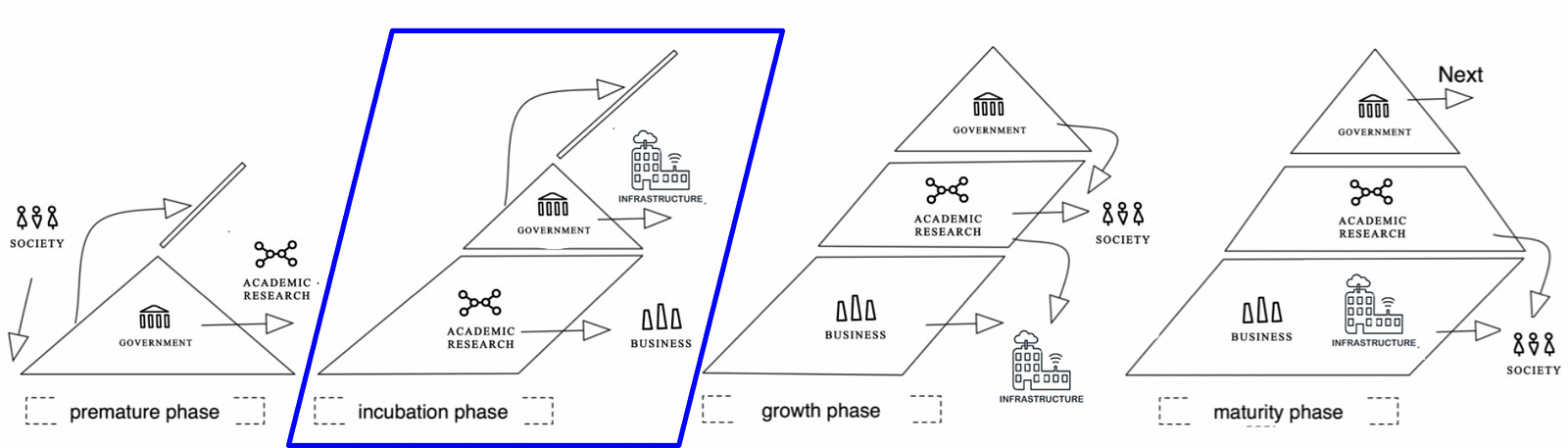
In the incubation phase, we have two targets: business at the R&D layer and infrastructure at the E&R layer. Next to an exploration of the L&R layer. The VUCA state will be challenging as no clear separation is seen between the R&D layer and the E&R layer yet. In the previous section, I mentioned this as a hybrid research community, instead of a clear separation between a community of practice (R&D layer) and a community of learning (R&E layer). The insight became clear by exploring the R&E layer.
We noticed PhD students needed to spend a lot of time with education tasks and they were scattered, so we talked to the center of excellence on CBL called Innovation Space. In a follow-up project, we should make sure the PhD students have shared education tasks and get Innovation Space involved. This would still not be what I anticipated for the R&E layer during the incubation phase, it seems Innovation Space would be more fitting with R&E during the growth phase.
The challenge is to build a leadership platform for a hybrid research community first and this aligns a lot with the activities of EIRES. The leadership platform is another tool: a Content Management System (CMS). For the hybrid research community, it will be CBL on ABM. EIRES was already involved in NEON. Today it is clear that EIRES would fit greatly with the requirement to start a leadership platform. The question will be, can we get EIRES committed to a follow-up project? Time will tell.
We expect the period of the incubation phase will be needed to bootstrap the hybrid research community until we can fork the CMS into two different communities (practice and learning). It starts with the core research team ( like the premature phase) and by the end of the project should look like the incubation phase. The leadership platform demonstrates how this works through exponential growth: every contributor should bring two new contributors. During the first year, the core research team (i.e. 10–30 researchers) would kickstart the growth and after 4 years it would have reached the target of 300 researchers.
Again a government board would be behind a research project, built by lessons learned from NEON and aligned with the TRL ladder. Also on the top layer, we expect a tool and it is being explored at the moment: Decentralized Autonomous Organisations (DAO). The three tools (ABM, CMS, and DAO) are abstract categories, leaving space for subtitle variety with the actual tool. For example in NEON the ABM is developed in Anylogic, the CMS I used during my PhD was Drupal, and I already explored DAO communities like DeSci and cityDAO. Now we don’t have experience with DAO so a follow-up project should make the exploration explicit. Just like NEON had several individual PhD topics exploring the outlines.
The exploration of the top layer needs to go beyond the support tool and also consider the institutions. We may have a weak signal of a pattern. Just like EIRES was involved with NEON and is hopefully now committed, we need to involve many more institutes internally (like Innovation Space) and externally. I’m considering talks with the United Nations and the Dutch Army because the central research challenge of the follow-up project would be PoPy logistics. We start with festivals and intend to expand to PoPy logistics like the use for disaster relief (see previous article).
In the first year, the whole team would be at the R&D level, with a target on business & infrastructure, kickstarting the leadership platform. In the next years, most will shift upwards to the E&R layer and focus on PoPy logistics. Some will stay at the R&D layer, with a target to a concrete venture (i.e. business). I’m currently calling it Green-Energy Assembly Rack (GEAR). The modules on the racks would be the size of a container, so mobile as in it can be moved with trucks. Each module contains components like wind, solar, battery, and grid infrastructure. The goal is to produce a serious amount of energy in the MegaWatt range. At the E&R layer most will focus on PoPy logistics and some will explore the STP-X theory. The follow-up research project would develop the NGU pillars as follows:
Pillar 1 education (TRL2) = leadership platform (ABM-CMS)
Pillar 4 transition (TR3@TRL2) = STP-X theory of a social ecosystem
Pillar 2 research (TRL4) = Popup Pyramid (PoPy) logistics
Pillar 3 validation (TRL5) = Green-Energy Assembly Rack (i.e. GEAR)
The TRL ladder gives us more detail on how dynamics shift: WP1–3 has interacting technologies, this should shift to ecosystem dynamics (i.e. coordination). WP4–6 has separate technologies and needs to interact by focusing on PoPy logistics. WP4–6 each has a team of 4 PhD students focused on their core strength. The shift implies a focus on joint strength. WP7–9 contains PhD students in individual topics, for rigorous examination of the STP-X a team of 4 PhD students is required, focused on their core strength. The integral model (WP10 & Zenmo) was at the front with the ABM development and now also at the back with CMS development, the basis of the IT support. Finally, some new PhD roles could be relevant. For example on open innovation (for the joined venture), on Human Computer Interaction (for the IT support), etc. To summarize:
Startup ecosystem (TR5): partners in a joined venture
Technology alignment (TR4): joined research focus, separate ventures
Research alignment (TR3): PhD micro-teams, separate research focus
Support alignment (TR2): individual PhDs i.e. exploring
5 STP-X proof of concept in practice (TRL3)
With business pulled in the R&D layer, academic research, and the government board are pushed up a layer. For both E&R and L&R, the target is society. So for L&R, the target is not at the same level i.e. the layer does not grow with the next transition phase. A new dynamic needs to be explained: the pushdown. The pushdown is also seen with infrastructure i.e. the previous E&R target now being the R&D target. This implies a community of learning has gained enough understanding to move the target to the community of practice. Similarly, the governance team should create a framework for societal needs so a community of learning can work on it.
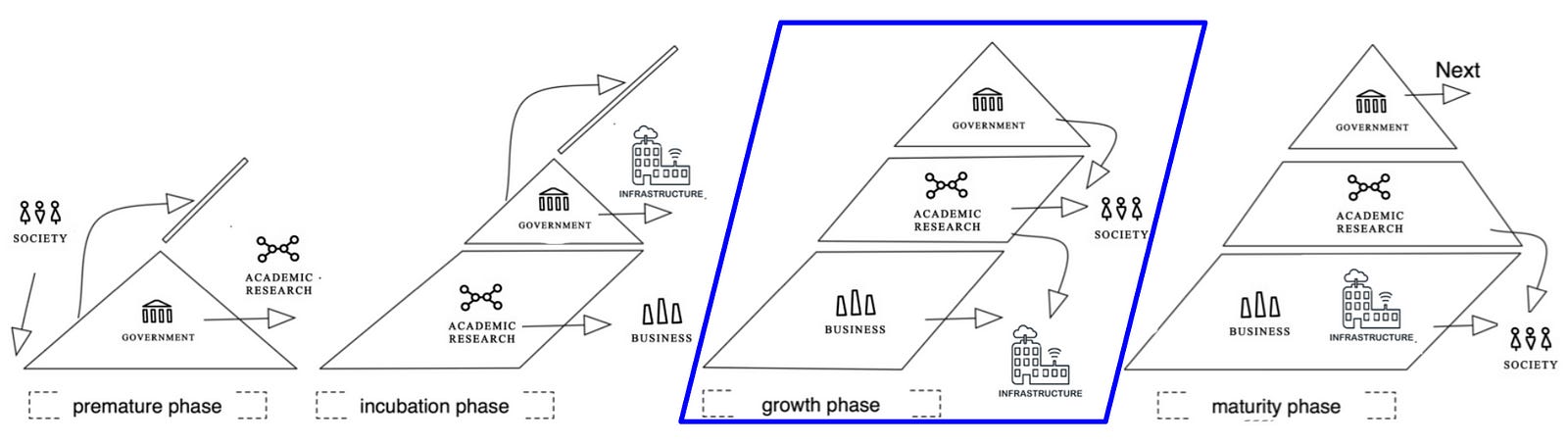
Just like with the incubation phase, the external target is pulled in and it will push up the other layers. The extra support tool in the growth phase is DAO developing a self-governing market for green energy. The green energy transition is ideal to demonstrate the DAO. Most of the required market dynamics, to be smart about energy consumption, already exist. With the leadership platform being forked for the community of practice and a community of learning, we see two E&R targets, one going to the R&D on infrastructure and one to the E&R on society. The arrow going to the infrastructure is PoPy logistics joining with the GEAR venture.
In theory (cybernetics), the incubation, growth, and maturity phases show a Meta-System Transition (MST: interaction, coordination, and control). This translates in practice as institutes getting involved (in-kind and in-cash), committed (using NGU technology for their mission), and in control (becoming a regulator in the NGU structure). Two recent institutes @TU/e were founded in 2020, that are involved with NEON: EIRES and Eindhoven Engine (EE). EIRES is internal to the TU/e and works outwards, while EE is external and works inwards. We hope EIRES becomes committed by being the subject of the leadership platform.
EE is cultivating a stronger relationship with businesses. In particular interesting is to develop a service for business support with: Environmental, Social, and Governance (ESG). At this moment no exploration with the growth tool (DAO) has been done. EE may be committed by creating a side project to explore ESG and DAO. Lessons learned for such a project would be used to engineer the DAO use in the growth phase. With both EIRES and EE committed in the incubation phase, the MST explains how they gain control in the growth phase.
The explanation of how control is gained is understood as cybernetic theory, but how it will unfold is unclear. Just like the PoPy method was understood in theory and only became clearer with the NEON project. The MST control relates to the Carburated Action Research (CAR) method. We expect the method to shift from theory to practice. The CAR method got its name as the cybernetic system looks a lot like a carburetor, where venture capital is the metaphorical fuel. It starts with recognizing the dynamics of converging evolution (CAR-funnel), the game of venture capital (CAR-venturi), and eventually how frameworks define a market (CAR-horn). The DAO revolution makes the concept of frameworks much richer.
To explain how control is gained in a way we can show how the L&R layer is a workspace for policymakers requires the introduction of the circulation of scientific facts. Bruno Latour in his book on Pandora’s Hope elaborates how the dynamic is behind science in action. The case he gives to explain the dynamic is the scientific project resolving the question: “Is the safana or the forest gaining ground?” Many field researchers collect samples in space and time. This is a dynamic related to the PoPy base layer. Next, a research team capable of analyzing the data creates scientific maps, i.e. related to the PoPy middle layer.
The scientific maps would become maps of meaning (a theory in clinical psychology). Part of the human factor research in the incubation phase is to understand how all the different theories help with STP-X. During the growth phase, we need to understand how maps of meaning and DAO can create the instrument we need, let me call it an ESG-DAO. The maps are the input for the workspace. If the maps can be actual sensory data, thanks to advancements by the Internet of Things (IoT), the full force of the PoPy dynamic will be visible.
The ESG-DAO is currently a theory. I mentioned other DAO projects like DeSci and cityDAO, they are not theories. DeSci is short for decentralized science demonstrating how science can be supported and validated in the future. CityDAO explores similar changes to city governance. The project is particularly interesting for popup cities. The use of DAO is still experimental, but very promising. In the next five years — hopefully by exploration of ESG-DAO with EE — it has to become practical, to be used as a tool for the PoPy method. This brings me back to the TRL ladder.
For the growth phase, the community of learning is targeted to society: developing tropic cascades by the circulation of scientific facts. This will make the community of learning much more of an academic community with students and researchers. The community of practice is targeted to infrastructure, bringing the insights on PoPy logistics a layer down and finding how the research can be validated to society. From logistics for events, to hopefully a good structure for disaster relief. Led by the GEAR venture this expands to green-energy logistics.
The human factor research would have figured out how to understand the dynamics to resolve STP-X in a social ecosystem. They are now central to the demonstration of the 4th pillar with ESG-DAO. This will also “flavor” the research focus. Earlier research on PoPy logistics still lacks the human factor to become a real living lab for urban development. Now the human factor needs to get more integrated so the research focus is towards living cities. Together this becomes:
Pillar 1 education (TRL2) = Circulation of scientific facts
Pillar 4 transition (TR3@TRL3) = demo the ESG-DAO
Pillar 2 research (TRL4) = living city (smart and social)
Pillar 3 validation (TRL5) = green-energy logistics
6 Crossing the maturity gap (TR4) and beyond
Considering this development would happen around 2040 should manage the expectations of the forecast. Most are theories, built on some weak signals. The only target left is society. The arrow at the top with P&R is about using lessons learned for another transition and not this one on zero-emission. The only target gives the illusion this phase is simple, but we need to consider the numbers involved.
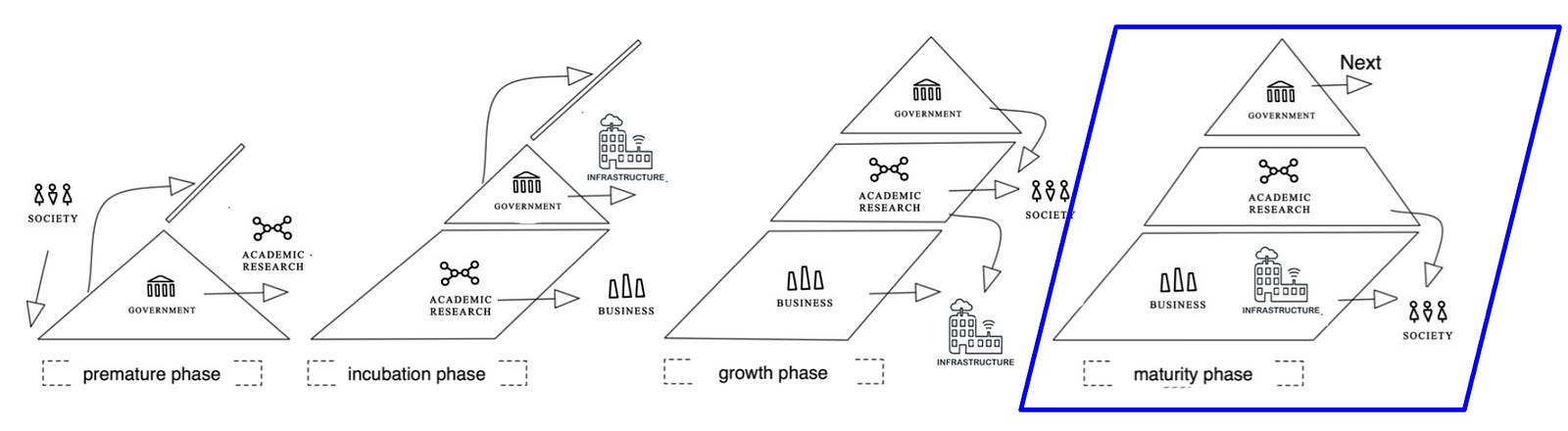
On top, we have a governance board (10–30 people), and researchers should be replaced by policymakers. Most governance would be self-organizing, this is a group doing the meta-regulation i.e. keeping the focus on the values to be protected, not the micro-management. A community of learning in the middle produces the maps of meaning (1k-3k students and researchers). At the base is a community of practice (10k-30k workers) being busy and creating the data for the upper layers. So far I’ve not mentioned AI. I’m emphasizing other less-known parts. AI already is all over the place. We expect AI institutes to get involved during the incubation phase, have an important coordinating role during the growth phase, and gain control in the maturity phase. Simply because of the numbers.
The community of learning has a size enough to trigger a hive mind experience. I mentioned earlier how PoPy was first described by cognition as how the brain works. Understanding and analyzing the hive mind experience, led to identifying the meta-brain setup (for details see the link above). If we can create a flow of collective intelligence with circulating facts and scale it up to the level of a hive mind experience we may well have created the cognitive capabilities for Brainport Eindhoven. This would validate the SoC theory on how to develop meta-life with collective intelligence. This is a lot of theory, the practical story is straightforward.
In general, the maturity phase is a moment when institutes will take over. To see the exponential acceleration, we would see the required numbers. Today at Innovation Space they do have 2000 students, so between the 1k-3k range required for the E&R layer. To see the required 10k-30k of R&D workers, we can look at the bigger companies in the region. For example, ASML has 14k R&D workers. ASM may be the biggest in the region, but other big players do exist. If we want the big players to be committed during the maturity phase, we should involve them during the growth phase and start talking to them once the incubation phase is active.
Involving the big players would most probably happen via the partners NEON already has. For example, Brainport is already involved in NEON. Brainport is an important mediator for big companies. The landscape ahead seems rich enough to expect the converging evolution to play out as expected.
Another way to gain some forecast is to look at the TRL ladder. Learning from the ESG-DAO demo, we can start building a framework (TR4). Turning the research on PoPy cities into practice gets us to actual living cities (TR5). The R&D layer is at this moment all about work, not yet about all aspects of life. The human factor research will keep being targeted to society. It is the input and output of the whole PoPy method. Remember how the PoPy process was recognized for collective intelligence to develop radical innovation. This is expected to translate in the NGU research pillar as the thing creating impact. Creating the following overview:
Pillar 1 education (TRL2) = Brainport cognition (meta-brain)
Pillar 4 transition (TR3@TRL4) = ESG-DAO framework
Pillar 2 research (TRL4) = Collective intelligence impact
Pillar 3 validation (TRL5) = living cities @ work
The maturity is not the last phase, yet in the last phase we see little change in the figure: society would be pulled in and the pyramid would be completed. It seems like hardly any change, but in the field, it is a huge change. Probably the most impactful change. The only layer still changing is the base layer. With a factor 10 increase, this would be 100k-300k. Numbers from the region, tell us the high-tech sector already has 250k R&D-related jobs, so the number is within range, but it will be a game for the Brainport region. In theory, this relates to Cosmopolitan localism.
The expansion to more R&D workers and the human factor research becoming applied should co-evolve with the development seen in self-governance. One weak signal not yet mentioned is Apps for Democracy (A4D), which happened in 2010 in many cities. I believe A4D has spilled over to DAO if not in practice then definitely in spirit. To wrap up a summary concerning the pillars. Only a slight change is seen with the 3rd and 4th pillars, now it is not about a popup city, but existing cities transforming:
Pillar 1 education (TRL2) = Brainport cognition (meta-brain)
Pillar 4 transition (TR3@TRL5) = ESG-DAO governance
Pillar 2 research (TRL4) = Collective intelligence impact
Pillar 3 validation (TRL5) = nucleus for a living city
In conclusion, the NGU roadmap has been elaborated in general. The task exists to now develop a follow-up project to kickstart the incubation phase. This article has refined the first part of the previous article. The previous article consisted of two parts, a practical part that led to the TRL ladder and a philophical part telling the big picture. The philophical part was from an evolutionary angle and I do want to write an article on the moral implications. This seems important, but not urgent. Working out the follow-up project has priority.